The AI that refuses to fake a number.
Rigor brings validated statistics to Six Sigma. You call the method first — then it checks every assumption in code, refuses the tests your data can't support, and computes every figure on a validated engine, never the language model. So the statistics behind your certification, your project, or your next decision actually hold up.
General AI picks a statistical method that doesn’t fit the data about one time in three.
StatQA · NeurIPS 2024 — and it computes the values correctly even less oftenThree ways in.
Just starting out, leveling up to Black Belt, or running real projects — each lane is built for where you actually are, with the same promise underneath: Rigor won't fake a number.
New to Six Sigma?
Everyone starts somewhere — White or Yellow Belt, not the deep end. Take the skills check and we'll show you exactly where you stand and where to begin — then Rigor coaches the judgment from there.
Green Belt → Black Belt
Ready to advance? Earn the jump with a project record you can actually prove — every figure computed, assumption-checked, examiner-verified.
You sign off on the analysis.
Rigor refuses tests your data can't support and computes every figure on a validated kernel — never the AI. Defensible to a boss, an auditor, a customer.
The p-value looked right. It nearly bought the wrong machine.
A Black Belt asked ChatGPT for a one-way ANOVA and got a clean, confident answer: p = 0.03 — significant, buy the equipment. The validated software said p = 0.21 — not significant. The AI hadn't calculated anything. It predicted what a plausible answer looks like.
This is the failure Rigor removes by design: it commits you to a method first, checks the assumptions in code, and computes every figure on the kernel — so the number you hand an examiner is one you can defend, not one that merely sounds right.
Watch it predict, compute — and refuse.
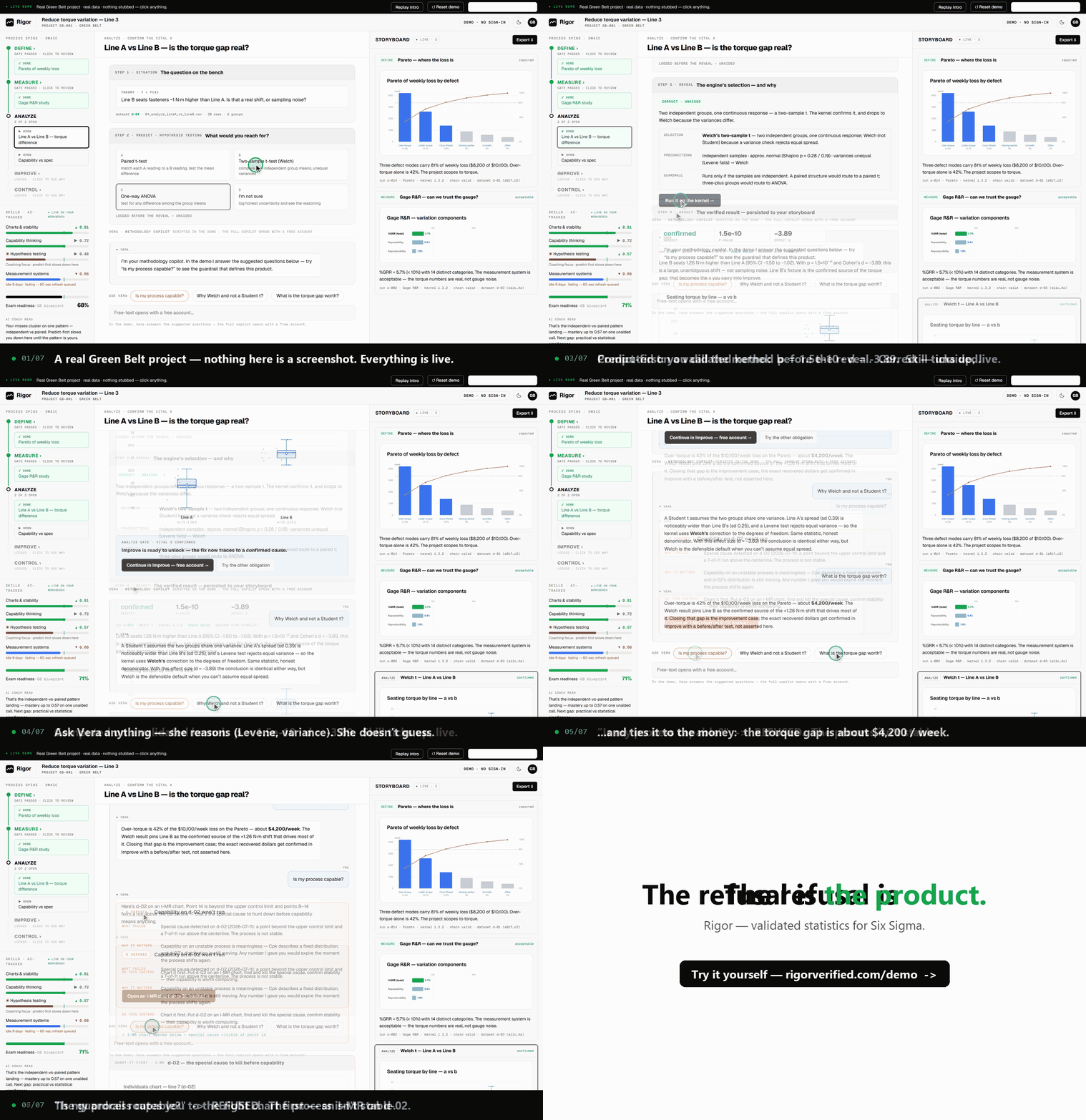
A real Green Belt project, start to finish: you call the method, the kernel computes the result, Vera reasons through your questions — and when the data can't support one, Rigor refuses. Every number on screen is computed. Nothing is staged.
Ask for an analysis.
Watch Vera run it — or refuse it.
Type a real request — or tap one below. Vera commits to the method she'd defend, runs it on a sample dataset — chart and computed result — and refuses the ones the data can't support. Every figure comes off the kernel, never the model.
The judgment layer, stage by stage.
Six gates between your raw data and a claim you can defend. The one in red is the one general AI skips.
Calibrate. Predict. Prove.
No tool menus, no 40-hour learning curve. One project, one methodology brain, and an interface that makes you better instead of dependent.
Calibrate
A short scenario assessment — five real situations — measures how you think, not what you've memorized. Rigor configures itself — coaching depth, mode, emphasis — and your answers become your measured baseline.
skill read: charts strong · hypothesis tests → coaching here
Predict-first bench
Before any analysis runs, you commit to your method call — then Rigor reveals its selection, the checked assumptions, and the why. Correct calls build your evidence log; misses become coaching.
run a-41f · kernel 1.3.2 · logged unaided
Verified storyboard
Your DMAIC storyboard assembles itself as you work — charts to SPC convention, every figure provenance-stamped. Export, then have the independent examiner verify it.
VERIFIED · VER-2026-08C41 · registry QR
An AI coach that knows
why you miss.
Calibration starts with a short skills assessment — and the gaps it finds become your coaching emphasis, automatically. From there, every method call you make updates a live mastery estimate per skill, tracked down the side of your workbench as you complete real work.
- Mastery, not gold stars — each skill carries a probability estimate that moves with every prediction you make
- Misconception diagnosis — the AI clusters your misses into named patterns ("independent vs paired," "mean-comparison trap") and coaches the pattern, not the incident
- Decay modeling — skills fade without practice; Rigor notices, and queues 60-second spaced drills before the exam does
- Exam readiness — everything rolls up against the actual certification blueprint, so "am I ready?" has a number
Answer-vending AI tutors made students score 17% worse on the unassisted exam. Rigor is built to move that number the other way — and to show you it moving.
Four walls between the AI and your project.
Minitab's AI summarizes results after you've already chosen the analysis. ChatGPT will compute capability on an unstable process without blinking. Rigor is built the other way around.
The AI never computes
Every statistic runs on a deterministic kernel validated against NIST and Minitab reference outputs. LLM output physically cannot contain a computed number — a post-processor enforces it.
The AI never freelances methods
Method selection runs through methodology playbooks and a DMAIC state machine. Preconditions are checked in code — an analysis whose assumptions fail doesn't run.
Everything is traceable
Every figure carries its run ID, dataset hash, kernel version, and your decision trail. Hand it to a grader, a boss, or an auditor — "how did you get this?" is answered on the page.
The AI never breaks the logic
Your project is one causal argument — Y=f(x), from problem to proof. Rigor keeps the thread: solutions must trace to confirmed causes, "improved" is a refused claim until post-change data proves it, and controls attach to the causes you actually verified.
"Run capability on this data." Your process shows a special cause on July 11 and fails the stability check. Capability on an unstable process is meaningless — let's chart it, find the cause, and then measure capability. That refusal is the product.
Don't just certify.
Get Rigor Verified.
Employers know certificates can be bought. So we built the thing they can check: an independent adversarial examiner re-computes every claim in your storyboard from your raw data — then issues a tamper-evident record any recruiter can verify in one click.
- Every figure recomputed on the kernel and diffed against your deck
- Method selection re-derived; assumptions re-checked; soft conclusions flagged
- Pass → Verified stamp, QR, and a public registry record
- Fail → a defect list and a free re-review, not a dead end
- Built your project in Minitab or Excel? Verify it anyway — any tool
- Sustainment re-check at 90 days — the examiner re-runs your frozen Control contract on fresh data (live connector or attested upload) and adds a second stamp: gains sustained
- No stamp is ever a failure mark — absence just reads "not re-verified"
Early belief, permanently rewarded.
The ladder steps down as we grow — earlier members get more, forever. We give away time and locked prices, never the credential: verification always costs something, because a registry only matters if its stamp can't be handed out. And the counters are real — a company named Rigor doesn't do fake scarcity.
Founding 100
- 6 months of Pro, free (worth $174)
- Project Pass included
- Verification locked at $49 forever
- Founding badge on your registry record
- Direct line to the founder — you shape v1
Charter 500
- 3 months of Pro, free (worth $87)
- 50% off the Project Pass
- Verification locked at $79 forever
- Charter badge on your registry record
- Founder line — Founding 100 only
Early 1000
- 1 month of Pro, free
- Early-adopter pricing locked at launch rates
- Early badge on your registry record
- Then: standard free tier for everyone, forever
Reserve your founding spot
Rigor isn't open to the public yet — we're onboarding the Founding 100 first. Leave your details and your spot is held, price locked, no card. Loading the live count…
Do the work free. Own it for $49.
Prove it for $99.
Your exam costs $295–438. Your prep course cost hundreds more. Rigor is the cheapest part of your certification — and the only part that produces checkable evidence.
Free
- Full predict-first coaching & guidance
- 1 active project · ~20 analyses
- Unlimited practice datasets
- Watermarked export
Project Pass
- Everything in Free, uncapped
- Clean .pptx / PDF export
- Provenance appendix + Locked mode
- Verification at $79
Pro
- Unlimited projects
- Auto mode (earned via calibration)
- Priority kernel runs
- Verification at $79
Verification
- Independent adversarial examiner
- Verified stamp + registry record
- Free re-review on fail
- Any tool — Minitab & Excel welcome
- 90-day sustainment stamp: +$39 prepaid · $59 later
Quality taught the world to verify before trusting.
Time our tools did the same. Five pilot spots open this month.
Join the founding waitlist